Make "Better" Your DXP Migration Strategy
For years, enterprise platform migrations followed the same playbook.
The objective wasn't to improve the digital experience. It was to recreate it, as faithfully as possible, on newer technology.
Teams spent months documenting every page, every component, every integration, and every edge case. Budgets were consumed rebuilding what already existed. When launch day arrived, success was measured by how little had changed.
That approach made sense. Traditional migrations left little room for anything else.
If you wanted better analytics, that became Phase Two.
If you wanted personalization, that came after launch.
If you wanted to modernize search, improve content operations, or refresh the design, those initiatives competed for future budgets and often never happened.
The migration itself consumed nearly all of the available time, money, and attention.
Artificial intelligence has fundamentally changed that equation.
AI isn't simply making developers more productive. It's changing the economics of implementation. Work that once required weeks of manual effort, analyzing existing sites, generating component foundations, mapping content, creating documentation, scaffolding code, and accelerating testing can now be completed dramatically faster with AI-assisted delivery.
That creates an opportunity many organizations haven't fully recognized.
Instead of spending an entire implementation budget recreating yesterday's website on a new platform, teams can use those same investments to deliver a meaningfully better digital experience from day one.
That's the mindset organizations should bring to every DXP Platform migration.
A new platform shouldn't just host the same experiences more efficiently. It should launch with better measurement, stronger discoverability, more intelligent search, meaningful personalization, modern content operations, and even a refreshed design when appropriate.
The goal is no longer migration.
The goal is to arrive on your new platform better than where you started.
Stop Thinking About Migration as a Technical Exercise
If AI has changed the economics of implementation, then it should also change how we define success.
For too long, migration projects have been measured by technical milestones: Was the content moved? Were the integrations rebuilt? Did every page make it to the new platform?
Those questions still matter, but they shouldn't be the primary measure of success.
The real question should be:
How much better is the experience on the day you launch?
AI-assisted delivery has dramatically reduced the effort required to analyze existing sites, generate modern component foundations, accelerate development, migrate content, and automate testing. Those efficiencies create capacity that simply didn't exist a few years ago.
Organizations now have a choice.
They can use AI to deliver the same website faster.
Or they can use AI to deliver a better website within the same investment.
The second option creates exponentially more business value.
Instead of recreating outdated analytics, establish a modern measurement framework that provides visibility into customer journeys from day one.
Instead of copying the same information architecture, improve discoverability through structured content, technical SEO, and AI-ready content that performs well in both traditional search engines and answer engines.
Instead of postponing personalization, identify a handful of high-value use cases that immediately demonstrate the capabilities of your platform.
Instead of migrating yesterday's search experience, take advantage of modern AI-powered search that understands user intent and helps visitors find answers more quickly.
Instead of carrying forward years of content debt, use AI to identify content that should be retained, retired, merged, restructured, or enriched before it reaches the new platform.
Even the visual experience deserves a second look. Design systems and AI-assisted engineering have made design refreshes significantly easier to implement during a migration than in the past. If your brand or user experience needs modernization, migration is often the most efficient time to make that investment.
None of these improvements require separate transformation programs.
They should be considered part of the migration itself.
A new platform is more than a technology upgrade. It's an opportunity to rethink how customers discover, experience, and engage with your brand.
Organizations that recognize this will launch with far more than a modern CMS.
They'll launch with a stronger digital foundation that's ready to deliver value immediately.
What Does "Better" Actually Mean?
It's easy to say a migration should deliver a better experience. The harder question is defining what "better" actually looks like.
For us, it starts with a simple principle: every migration should leave your organization in a stronger position than it was before. Not just on a new platform, but with a better foundation for growth.
Better Visibility
One of the biggest changes over the past two years isn't the technology powering websites. It's how people discover them.
Traditional search is no longer the only front door to your brand. Prospective customers are increasingly finding answers through ChatGPT, Google's AI Mode, Perplexity, and other AI-powered experiences before they ever visit your website.
A platform migration is the ideal opportunity to improve your visibility across both traditional search engines and AI discovery platforms.
That means strengthening technical SEO, implementing structured data, improving internal linking, modernizing information architecture, enriching metadata, and creating content that's easier for AI systems to understand, cite, and recommend.
Don't simply migrate your existing content. Make it easier for people, and AI, to find.
Better Measurement
Visibility is only valuable if you can understand what's working.
Too many organizations migrate their existing analytics configuration without asking whether they're collecting the right data or measuring the right outcomes. A migration is the perfect opportunity to establish a modern measurement framework that supports continuous optimization.
Define meaningful business KPIs. Standardize events across customer journeys. Create a consistent data layer. Build dashboards that connect digital experiences to business outcomes. Build the foundation for future experimentation, personalization, and AI-driven decisioning.
When your new platform launches, your teams shouldn't be wondering what success looks like. They should already have the data to measure it.
Better Experiences
One of the biggest missed opportunities in platform migrations is postponing personalization.
Organizations invest in powerful platforms, but often delay using their capabilities until months, or even years, after launch.
Instead, identify a handful of high-value personalization use cases that can be delivered from day one. Whether it's tailoring content for returning visitors, surfacing relevant content based on visitor intent, or creating more contextual customer journeys, these experiences demonstrate immediate business value while establishing the foundation for more sophisticated personalization over time.
Your migration shouldn't just launch a new website. It should launch smarter experiences.
Better Search
Search is one of the most underutilized capabilities in modern digital experience platforms.
Too often, organizations implement just enough to replace what they had before. They index their content, configure a search box, and consider the project complete. The capabilities that deliver the greatest value, such as relevancy tuning, personalization, recommendations, behavioral insights, synonym management, boosting, merchandising, and continuous optimization, are postponed indefinitely.
A migration is the perfect opportunity to change that mindset.
Whether you're implementing a native search feature of your platform or investing in a modern search platform, success shouldn't be measured by whether users can search. It should be measured by how quickly they find what they need, how confidently they complete their journey, and how effectively search influences business outcomes.
That means investing in relevancy from the start. Understanding search intent. Designing meaningful search experiences for different audiences. Surfacing related content and recommendations. Using behavioral signals to continuously improve results. Connecting search insights back into your content strategy and personalization efforts.
Search shouldn't be treated as another integration to configure.
It should be treated as one of the most important customer experiences on your website.
Like every other aspect of a platform migration, the goal isn't simply to implement the technology. It's to unlock the full value of the investment from day one.
Better Content Operations
A modern digital platform isn't just about what visitors experience. It's also about how marketing teams create, manage, and optimize content.
Most DXP platforms have introduced entirely new ways of creating, reviewing, optimizing, classifying, governing, and publishing content using AI. Rather than treating these capabilities as future enhancements, organizations should design their content models, workflows, and governance around them from the beginning.
The result isn't simply a better website. It's a faster, more efficient marketing organization that can respond to new opportunities with greater speed and consistency.
Better Design
For years, organizations separated platform migrations from design refreshes because each required significant investment.
AI-assisted engineering and design-system-driven development have changed that equation.
Modern component architectures make it dramatically easier to apply an updated Figma design system across an entire website during a migration. If your brand or user experience needs modernization, migration is often the most efficient and cost-effective time to make that investment.
A new platform deserves more than a new backend. It deserves an experience that reflects where your brand is today.
Better From Day One
None of these improvements should be deferred to a future roadmap simply because that's how migrations have traditionally been delivered.
When AI removes much of the repetitive engineering effort, organizations gain the flexibility to invest more time improving the experience itself.
That's the real opportunity.
The goal isn't simply to launch on the new platform.
The goal is to launch with a platform that's easier to discover, easier to measure, more personalized, easier to operate, easier to search, and better designed for the future.
How We Approach Migrations at Altudo
We believe every DXP Platform migration is an opportunity to create a stronger digital foundation, not simply recreate what already exists.
That's why our approach starts with FastLane.
FastLane isn't just an AI accelerator that helps us migrate websites faster. It fundamentally changes how we deliver projects. By using AI to analyze existing websites, identify templates and components, generate modern foundations, accelerate engineering, assist with content migration, automate testing, and produce documentation, FastLane dramatically reduces the time spent on repetitive implementation work.
Those efficiencies allow us to invest more time where it creates the greatest value: making your digital experience better.
Instead of asking, "How do we rebuild this website?" we ask, "How do we improve it?"
That conversation begins with business outcomes.
Through our Business Value Framework (BVF), we work with stakeholders to identify the customer journeys and organizational objectives that matter most. Whether the goal is increasing acquisition, improving self-service, driving donations, growing commerce revenue, or reducing operational costs, every implementation decision is aligned to measurable business outcomes rather than technical requirements alone.
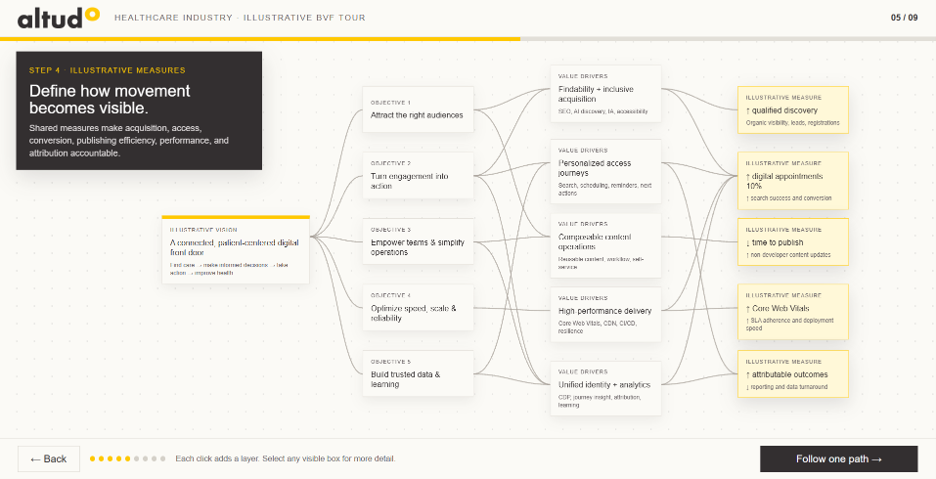
From there, we facilitate a series of strategy workshops that help organizations maximize the value of the platform from the moment they launch.
Together, we define a measurement strategy that connects digital experiences to business outcomes. We evaluate your visibility across both traditional search engines and AI discovery platforms, creating a roadmap for improving SEO, GEO, and AI discoverability. We identify meaningful personalization use cases that can be delivered at launch and establish a roadmap for continuously expanding those experiences over time. We help define how modern capabilities like Search, Agentic AI, and AI-assisted content operations become part of your day-to-day operating model, not just features that happen to be licensed.
Only then do we begin implementation.
Because FastLane has already accelerated much of the repetitive engineering work, our teams can focus on the areas that create lasting business value.
We spend time tuning search relevance instead of simply configuring search. That means understanding customer intent, refining relevancy, optimizing synonyms, implementing recommendations, and ensuring users consistently find the most valuable content, products, providers, or services. Search isn't considered complete because it works. It's successful when it helps customers accomplish their goals faster.
We make sure you launch with meaningful personalization, not just a personalization platform waiting to be configured. We prioritize high-value use cases that immediately improve customer experiences while creating a roadmap for expanding personalization over time. Personalization isn't a feature you implement once. It's an operating philosophy of continuously learning from customer behavior and delivering increasingly relevant experiences.
We establish measurement frameworks that give your teams visibility into customer behavior and business outcomes from day one, creating the foundation for continuous optimization and informed decision making.
We modernize your content strategy and operating model, helping marketing teams take advantage of capabilities like Agentic Studio to improve content creation, governance, optimization, and publishing workflows.
And because design-system-driven development is built into FastLane, we can often modernize the visual experience during the migration itself. Instead of carrying yesterday's design onto tomorrow's platform, organizations can launch with a refreshed experience that better reflects their brand and customer expectations.
The result is more than a successful migration.
It's a website that's easier to discover, easier to measure, easier to manage, more relevant, more personalized, and built to continuously improve.
That's what we believe a DXP Platform migration should deliver.
And that's how we approach every implementation at Altudo.